Net-Zero: Challenges, Policy Outlook, and Opportunities in India
Introduction
India has committed to achieving net-zero emissions by 2070, as announced by Prime Minister Narendra Modi at COP26. This ambitious target aligns with the global urgency to combat climate change while ensuring economic growth. However, achieving net-zero emissions presents significant challenges that require well-structured policies and innovative solutions.
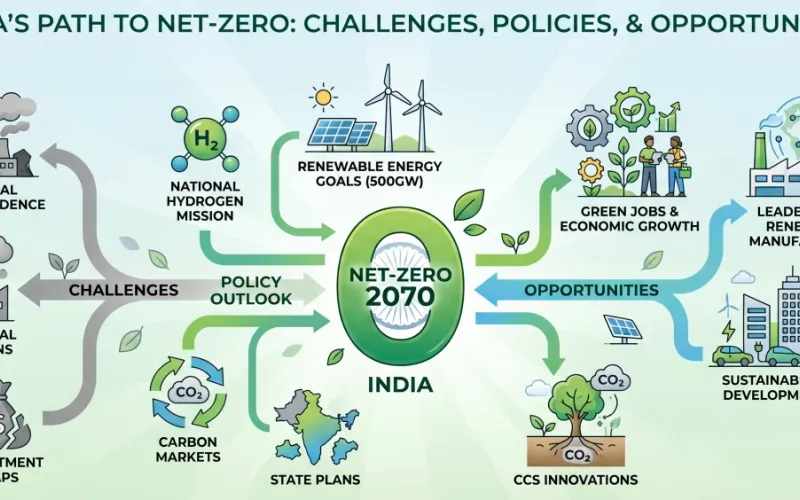
Challenges in Achieving Net-Zero
1. Heavy Reliance on Fossil Fuels
India's energy mix is still dominated by coal, which accounts for nearly 55% of the country's electricity generation (Central Electricity Authority, 2023). Reducing this dependency requires large-scale investments in renewable energy.
2. High Industrial Emissions
The industrial sector contributes approximately 30% of India's total greenhouse gas emissions (IEA, 2022). Heavy industries like steel, cement, and chemicals need innovative decarbonization strategies, including carbon capture and green hydrogen adoption.
3. Investment and Financing Gaps
A transition to net-zero will require an estimated $10 trillion by 2070 (Council on Energy, Environment, and Water, 2021). Mobilizing this level of finance remains a challenge, especially for emerging clean technologies.
4. Infrastructure and Technological Barriers
India's current power infrastructure needs significant upgrades to integrate a high share of renewables. Battery storage and grid modernization are crucial to support the intermittent nature of wind and solar energy.
Policy Outlook
1. India's National Hydrogen Mission
Launched in 2021, this initiative aims to make India a global hub for green hydrogen production, targeting 5 million metric tonnes of hydrogen production annually by 2030 (MNRE, 2022).
2. Renewable Energy Expansion Goals
India aims to install 500 GW of non-fossil fuel capacity by 2030, which includes solar, wind, and nuclear energy (MNRE, 2023).
3. Carbon Markets and Pricing Mechanisms
The Energy Conservation (Amendment) Act, 2022, introduced a carbon trading framework to incentivize industries to reduce emissions through market-driven mechanisms.
4. State-Level Climate Action Plans
Several states, including Gujarat and Maharashtra, have announced their own net-zero targets and are investing in regional climate resilience projects.
Opportunities for India
1. Green Jobs and Economic Growth
The clean energy transition could create over 50 million jobs in India by 2047 (NITI Aayog, 2023), boosting economic growth while reducing emissions.
2. Global Leadership in Renewable Manufacturing
India is already the world's third-largest solar market and has a strong manufacturing base for solar panels and wind turbines (IRENA, 2023). Strengthening domestic manufacturing under initiatives like Atmanirbhar Bharat can further enhance India's global position.
3. Sustainable Urban Development
Smart city initiatives and enhanced public transport infrastructure can play a crucial role in reducing urban emissions. India's electric vehicle (EV) market is projected to reach $150 billion by 2030 (IEA, 2023).
4. Carbon Capture and Storage (CCS) Innovations
R&D in CCS technology can help mitigate emissions from hard-to-abate sectors. Several pilot projects are underway, backed by government and private investments.
Conclusion
India's path to net-zero is filled with challenges but also presents transformative opportunities for economic and technological advancement. With the right policy framework, financial backing, and technological innovation, India can position itself as a global leader in sustainable development.
Your business has the power to lead India's net-zero transformation.
- 🔋 Adopt clean energy solutions - Transition to solar, wind, or hybrid energy sources to reduce your carbon footprint and operational costs.
- 🏭 Integrate sustainable practices - Implement energy-efficient technologies, carbon capture methods, and circular economy strategies within your operations.
- 💰 Invest in green innovations - Leverage government incentives and market opportunities to drive growth in renewable energy, hydrogen, and carbon trading.
- 🌏 Partner for sustainability - Collaborate with like-minded businesses, policymakers, and stakeholders to accelerate India's net-zero goals.
Take action today — position your business as a sustainability leader in India's low-carbon future! Get in touch with our expert at [email protected].